Case study · nātal
Building nātal's lifecycle program from scratch — and lifting paid conversion +57% with targeted emails
A case study by Daphne Tideman and Alice Muir Kocourková using PostHog and Customer.io.
I was brought onto the nātal project by Daphne Tideman Ltd. My scope was lifecycle: I built the program from scratch. The two sequences below are the ones we could measure against holdouts.
The Challenge: The Web Funnel Was Winning — and Still Leaking
nātal acquires most of its subscribers on the web: users discover the brand, sign up, and start a trial or purchase directly in the browser. The web funnel itself had been optimized hard and was performing well.
But a high-performing funnel creates a subtle trap: when the top-line conversion numbers look healthy, it's easy to declare victory at the point of purchase. The reality was that two groups of users were quietly falling through the cracks around the funnel:
- Paying users who never made it to the product. nātal's product lives in the app, but the purchase happens on the web. A meaningful share of paying subscribers never completed the jump from web checkout to app download — which meant they were burning through their trial without ever experiencing what they'd paid for. Early churn was baked in before day one.
- Signups who stalled before converting. On the other side of the purchase line, users who signed up for a nātal account on the web but dropped off before starting a trial or buying simply… disappeared without any follow-up or lifecycle nurture.
The Solution: Build the Lifecycle Program From Scratch
I owned lifecycle, starting from an empty calendar. That meant building the whole thing: mapping the customer journey, finding the moments where a message could change what happens next, and then writing, building, and measuring the sequences against holdout groups.
Rather than “send more email,” each gap was framed as a falsifiable hypothesis with a clear success metric:
Hypothesis 1: If we remove the friction between web purchase and app download through timely emails which include QR codes as well as links to the App Store listing, more paying users will experience the product before their trial expires — reducing early churn.
Hypothesis 2: If we reach out to users via email, with objection handling (e.g. common FAQs), reinforcement of the user goal and potential outcome as well as reassuring content, we may be able to improve the volume of overall new subscription starts, from users who originally started the funnel but dropped out before converting.
The measurement design mattered as much as the messaging. Both sequences ran against holdout groups — users deliberately excluded from the emails — so every lift reported below is incremental over what would have happened anyway, not correlation dressed up as causation.
Execution: Timely, Value-Anchored, Segmented
Sequence 1 — the web-to-app activation series. A multi-day email sequence built in Customer.io, triggered by a web purchase without a corresponding app download. The emails were deliberately value-anchored rather than instructional — leading with what the user would get in the app in their specific life stage, not “here's the App Store link” — with the download as the natural next step rather than the headline demand.
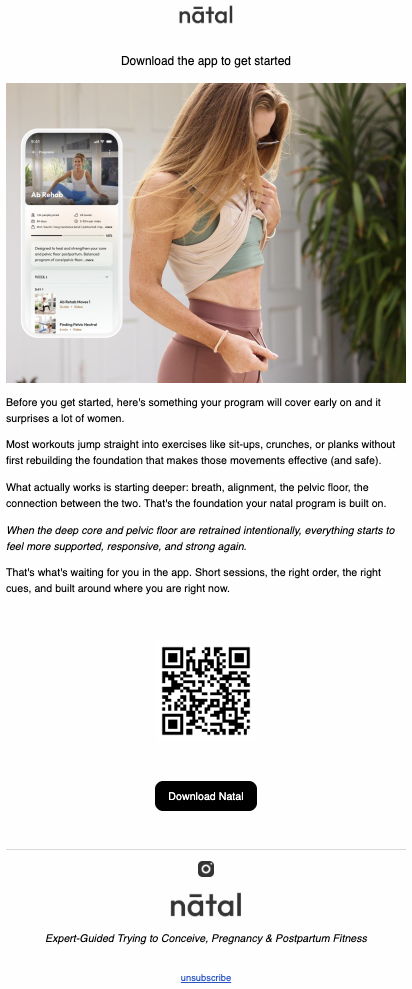
“One thing your core needs right now”
Open full size ↗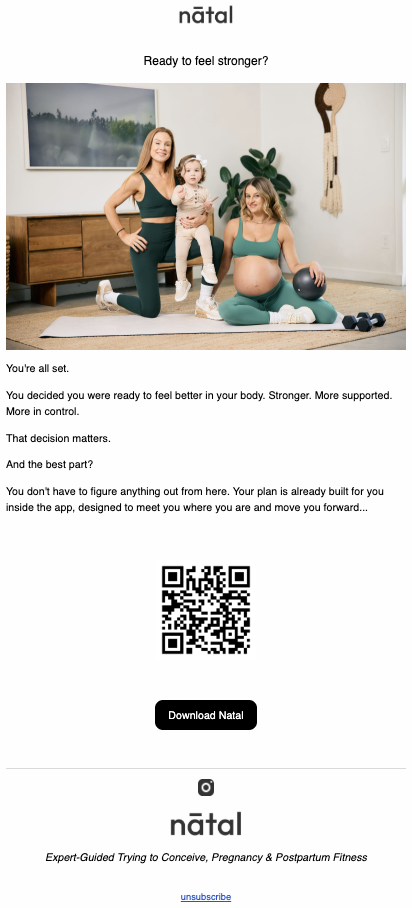
“Don't forget to download nātal”
Open full size ↗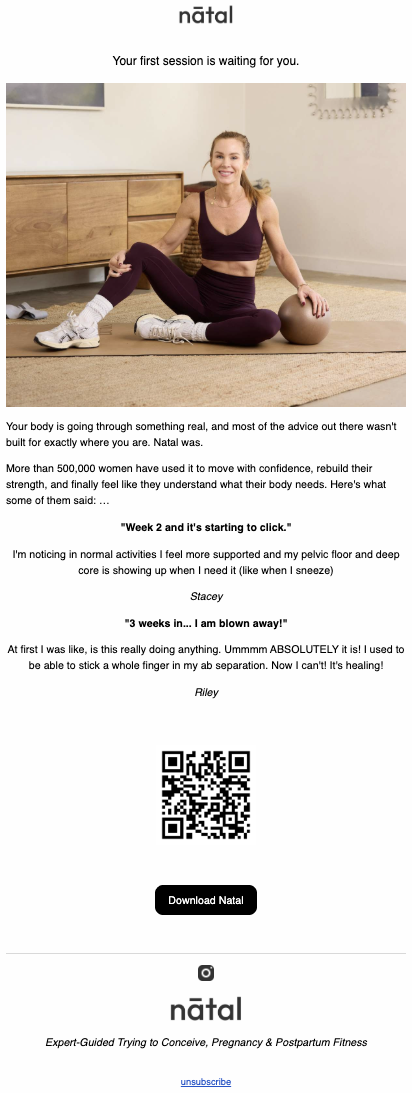
“Here's what 500,000 women found”
Open full size ↗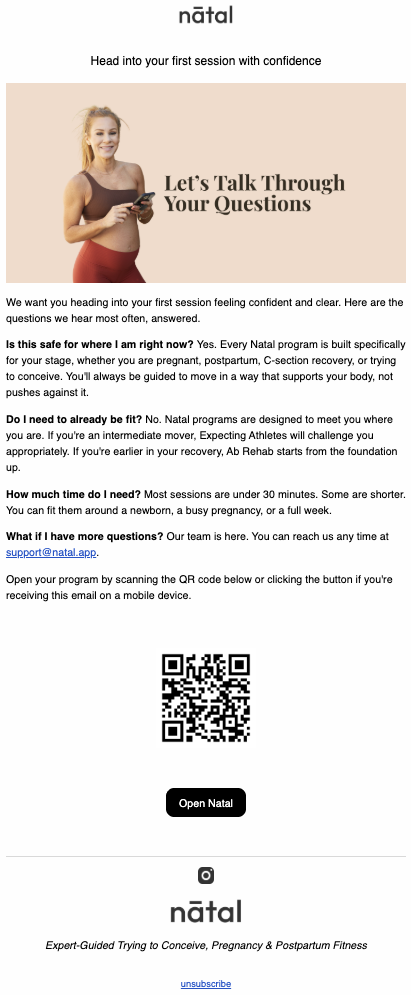
“Questions before you start? We've got you.”
Open full size ↗
Sequence 2 — the pre-conversion nurture series. An email flow targeting users who signed up on the web but stalled before starting a trial or purchasing, re-engaging them around the outcome they originally came for and routing them back to the paywall.
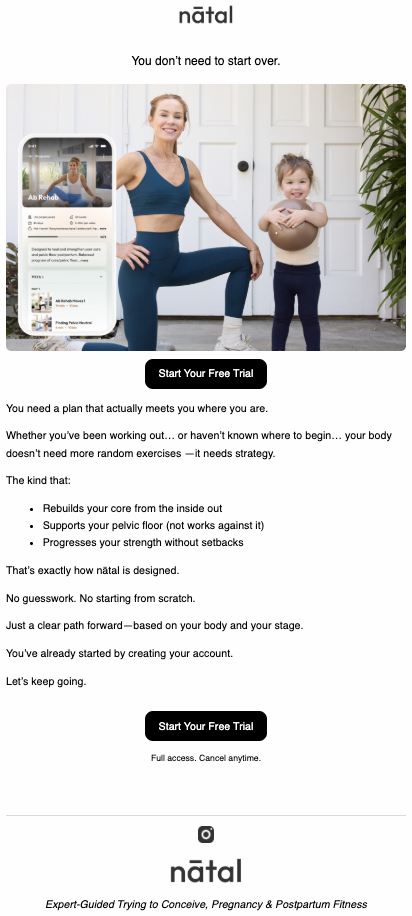
“You're one step away from feeling strong again.”
Open full size ↗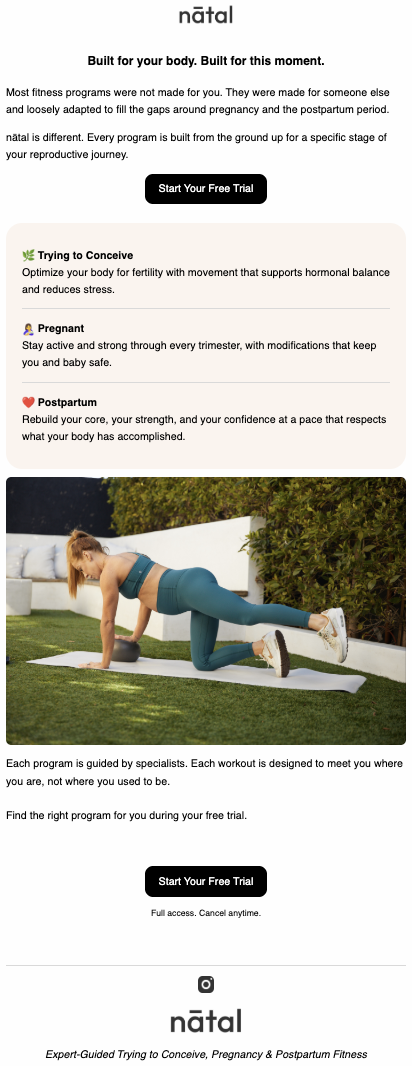
“This is not a generic fitness app”
Open full size ↗
The Results: Incremental Lift on Both Sides of the Purchase
The activation series lifted post-subscription app activation from 75% to 82% — a +9% relative lift, statistically significant, and consistent across both trial and direct-purchase cohorts. That's a meaningful share of paying users who now experience the product before their trial expires, instead of churning without ever opening the app.
The pre-conversion series converted messaged users at a +57% relative lift. Because of the holdout design, the sequence added additional incremental conversions per month that would not have happened without it.
Other things we tested
Winback for lapsed users. A series of push notifications and emails aimed at users who had lapsed for at least five days. It produced an estimated 15 percentage point incremental lift in getting those users back into the app to complete a program day.
Completing the fourth workout. A series of targeted push, email and in-app messages aimed at ensuring postpartum users complete their fourth workouts within the first two weeks of being a user. This flow was recently launched and we don't yet have statistically significant results.
“Working with Daphne and Alice helped us identify moments where women needed more support getting started with nātal. They brought thoughtful strategy and messaging to that process, with a clear focus on helping members take the next step and experience what our programs offer. I appreciated how collaborative they were and how well they understood the women we serve.”
The Takeaway: A Great Funnel Still Needs Connective Tissue
The instinct at most subscription apps is to treat CRM as a retention channel — something you invest in after acquisition and conversion are solved. This engagement points at the opposite: some of the highest-ROI lifecycle work sits directly inside the conversion story.
A web funnel, however well optimized, has structural blind spots. It can't follow a paying user across the gap between checkout and app download, and it can't chase a signup who closed the tab. Email can do both — cheaply, measurably, and without touching the product roadmap.
The reusable lesson: map where users exit the funnel's field of vision, and put a lifecycle touchpoint at each of those points before spending another euro widening the top. And whatever you send, run it against a holdout — incremental lift is the only number that survives scrutiny.
FAQ: Lifecycle Programs for Web-First Subscription Apps
What share of users typically don't download the app after purchasing on the web?
Roughly 20% is to be expected, even in a healthy web-first funnel — some non-download is structural, and no email series will get it to zero. That benchmark is what made nātal's starting point actionable: at 75% activation, a quarter of paying subscribers weren't reaching the product, meaningfully worse than the ~80% you'd expect. The email series closed most of that gap, lifting activation to 82% — slightly better than benchmark.
What conversion rate should you expect from emailing users who dropped off before starting a trial?
1–3% is the normal range — most of these users left for a reason, and email wins back a minority. That has a practical consequence: this tactic only really works on funnels with meaningful scale, where 1–3% translates into volume worth the build.